The Deepest Fish on Earth Can Never Come to the Surface
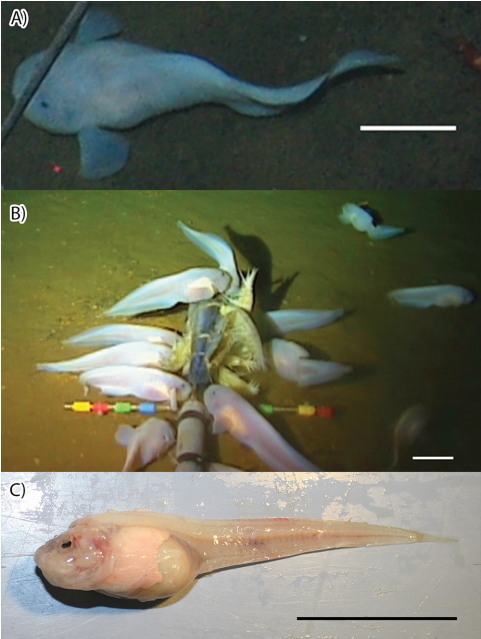
In 2023, scientists lowered a camera into the Izu-Ogasawara Trench, south of Japan, and filmed a small, pale fish calmly swimming at 8,336 meters (27,349 feet) below the surface. It was the deepest fish ever recorded — deeper than two Mount Everests stacked on top of each other is tall.
Built backwards on purpose
Down there, the water pressure is more than 800 times what you feel at the surface. Almost no fish can survive it — their bodies are simply not built for it. The snailfish survives because its body breaks every rule: it has no scales, almost no bones, a soft, jelly-like body, and a skull that never fully closes.
That softness is not a weakness. It is the whole trick. A rigid body would crack under the pressure. The snailfish's gel-like body lets the pressure pass through it — the crushing deep actually holds it together.
The curse of the deep
But this perfect design comes with a trap. A snailfish can never swim up. Near the surface, without the pressure its body depends on, its soft tissues fall apart. Snailfish brought up in nets arrive dead and disintegrating — the animal is a prisoner of the deepest water on Earth.
The expedition team, from the University of Western Australia and the Tokyo University of Marine Science and Technology, believes fish simply cannot live deeper than about 8,400 meters. Which means this little fish was filmed almost exactly at the edge of what life allows.
Quick Facts
- Deepest fish ever filmed: 8,336 m, Izu-Ogasawara Trench, Japan (2023)
- Water pressure there: over 800 times surface pressure
- No scales, almost no bones, and a skull that never fully closes
- Its soft body depends on pressure — it falls apart near the surface
- Scientists estimate ~8,400 m is the absolute limit for any fish
Watch the deep come alive
Every week we film the ocean's strangest creatures on our YouTube channel.
Subscribe to Trench BorneFrequently Asked Questions
What is the deepest fish ever found?
A snailfish of the genus Pseudoliparis, filmed at 8,336 meters in the Izu-Ogasawara Trench in 2023 — the deepest fish ever recorded on camera.
Why can't a snailfish survive at the surface?
Its soft, gelatinous body is built for extreme pressure. Without that pressure, its tissues lose structure and the fish dies — it is adapted to the deep the way we are adapted to land.
How deep can fish live?
Scientists estimate the limit is around 8,200–8,400 meters. Below that, the chemistry of fish cells cannot resist the pressure, no matter the species.
